
When Technology Pretends to be Science
Bantam Joe's article

I was honored the Bantam Joe mentioned my article on science and technology today. I have great respect for his writings and have been following him, and interacting with him, for the last ten years.
When Technology Pretends to be Science
Bantam Joe
I recently read Emanuel Pastreich’s article, When Technology Buried Science in a Shallow Grave. “The Fourth Industrial Revolution”, and I found it important because it speaks directly to a crisis I have been thinking about for a long time. It put into words something many people already feel. We are living through a crisis in science, but not only because of bad studies, corrupt institutions, or public distrust. The deeper problem is that we have started treating technology as if it were the same thing as science.
They are not the same.
Science is supposed to search for truth. It tests claims, checks evidence, admits error, and corrects itself. Technology is the use of tools to produce results. A tool can be useful, but it can also be destructive. A machine can be impressive and still be harmful. A system can be efficient and still work against human life.
That is the danger in front of us. Modern society looks at artificial intelligence, smartphones, data centers, digital platforms, smart cities, surveillance systems, automated logistics, and financial algorithms, then calls all of it progress. But progress toward what? More speed does not mean more wisdom. More data does not mean more truth. More automation does not mean more freedom.
A society can become more advanced while becoming less human.
The problem is not that people use tools. Human beings have always used tools. The problem begins when technology becomes the main organizing force of society. Once efficiency, automation, prediction, profit, and control become the highest goals, the human being gets reduced to a function inside a system. The worker becomes a labor cost. The citizen becomes a data profile. The student becomes a metric. The patient becomes a billing code. The child becomes an attention target.
We can already see this in ordinary life. Smartphones and social media have changed how people think, read, speak, and spend time. These systems are not neutral. They are built to capture attention, collect data, shape behavior, and sell access to users. The result is a public that is distracted, monitored, anxious, and easier to influence. The internet gives access to information, but it also floods people with advertising, propaganda, pornography, outrage, entertainment, and algorithmic manipulation. We have more information than any generation in history, but not necessarily more judgment.
The same pattern is spreading through schools, hospitals, courts, banks, government agencies, and workplaces. Artificial intelligence is sold as assistance, but in many cases it is also a replacement system. Companies use automation to cut labor. Schools use digital tools to track and measure students. Hospitals and insurers use software to manage care. Courts and agencies are experimenting with automated decision systems. Banks, employers, advertisers, and platforms use data to predict behavior.
The public is told this is about convenience and efficiency. In practice, more decisions are being moved away from human judgment and into systems most people cannot inspect, appeal, or understand.
This is where the crisis in science becomes serious. Science should protect society from false claims and reckless systems. It should test assumptions and study consequences before powerful technologies are pushed into daily life. But much of modern science is tied to grants, patents, corporations, military funding, government policy, university prestige, and institutional politics. That does not mean all scientists are corrupt. Many are honest people doing serious work. But the system around them often rewards funding, publication counts, institutional loyalty, and market usefulness more than independent truth-seeking.
That is one reason public trust is falling. People are told to “trust the science,” but real science never required blind obedience. Real science welcomes questions. It survives criticism. It tests its own claims. It does not treat computer models as holy objects. It does not silence dissent by appealing to credentials. It does not confuse institutional consensus with truth.
When scientific language is used to defend policies, products, or technologies that ordinary people are not allowed to question, science stops acting like science. It becomes a management tool.
Advanced computing gives a clear example. Supercomputers and data centers could be used to study soil depletion, food security, clean water, disease, pollution, energy stability, and public health. Some of that work is being done. But enormous amounts of computing power are also used for advertising, financial speculation, surveillance, automated trading, behavior prediction, military systems, logistics control, and corporate optimization.
A society reveals its priorities by what it chooses to calculate. If its most powerful machines are used to maximize profit, monitor populations, and automate human labor, then we should not pretend the result is simply scientific progress.
Artificial intelligence makes the situation more urgent. AI depends on massive data centers, huge electrical demand, water for cooling, rare materials, global supply chains, and constant data collection. These systems are often described as virtual, but they are not floating in the clouds. They sit on land. They draw power. They use water. They require substations, fiber lines, backup generators, cooling systems, security fences, zoning approvals, and political support.
Communities are often given little real say over how this infrastructure changes local life. The costs are physical, local, and long term.
The deeper concern is that human participation may become less necessary to the systems being built. Automated systems can already place orders, move money, route shipments, manage warehouses, monitor equipment, approve transactions, and trigger maintenance. In a machine-to-machine economy, one automated system can request a part, another can manufacture it, another can ship it, another can pay for it, and another can verify delivery.
The human being is no longer central to the transaction. The machine becomes the customer.
That may sound efficient, but efficiency is not the same as a good society. If work is automated, money becomes programmable, identity becomes digital, access becomes permissioned, and services are controlled by algorithms, then ordinary life becomes conditional. A person may still be physically free, yet unable to function without approval from digital systems. Banking, travel, employment, health care, communication, education, and public services can all become tied to credentials, accounts, scores, and permissions.
This is not far-fetched. Accounts can already be frozen. Platforms can remove users. Banks can flag transactions. Employers screen applicants through software. Governments link services to digital records. The more society moves into automated systems, the more power shifts away from people and toward whoever controls the infrastructure.
The danger is not only surveillance. The danger is dependency.
Technology rarely arrives as open oppression. It arrives as convenience. It promises faster service, better security, easier payments, personalized recommendations, smarter tools, and lower costs. Then, after people become dependent on it, the old alternatives disappear. Cash becomes rare. Human service desks are replaced by chatbots. Local stores close. Paper records vanish. Manual skills decline. Personal judgment is replaced by automated scoring. What began as convenience becomes necessity.
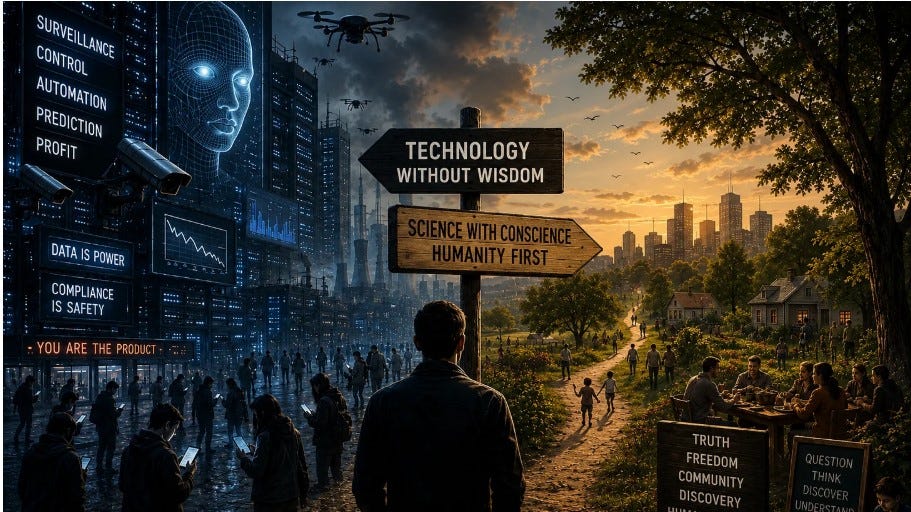
That is why Pastreich’s distinction between science and technology is so important. Science should ask whether these systems are true, safe, necessary, and morally justified. Technology only asks whether they can be built, scaled, sold, and integrated. When technology leads and science follows behind to justify it, society is already moving in the wrong direction.
The proper order should be wisdom first, science second, technology third. Today, that order is often reversed. Technology drives the agenda, finance funds it, institutions defend it, and science is brought in afterward to give it legitimacy.